


Kamikaze Collection
KMKZ PRIMER DEGREASING
KMKZ PRIMER DEGREASING
Couldn't load pickup availability
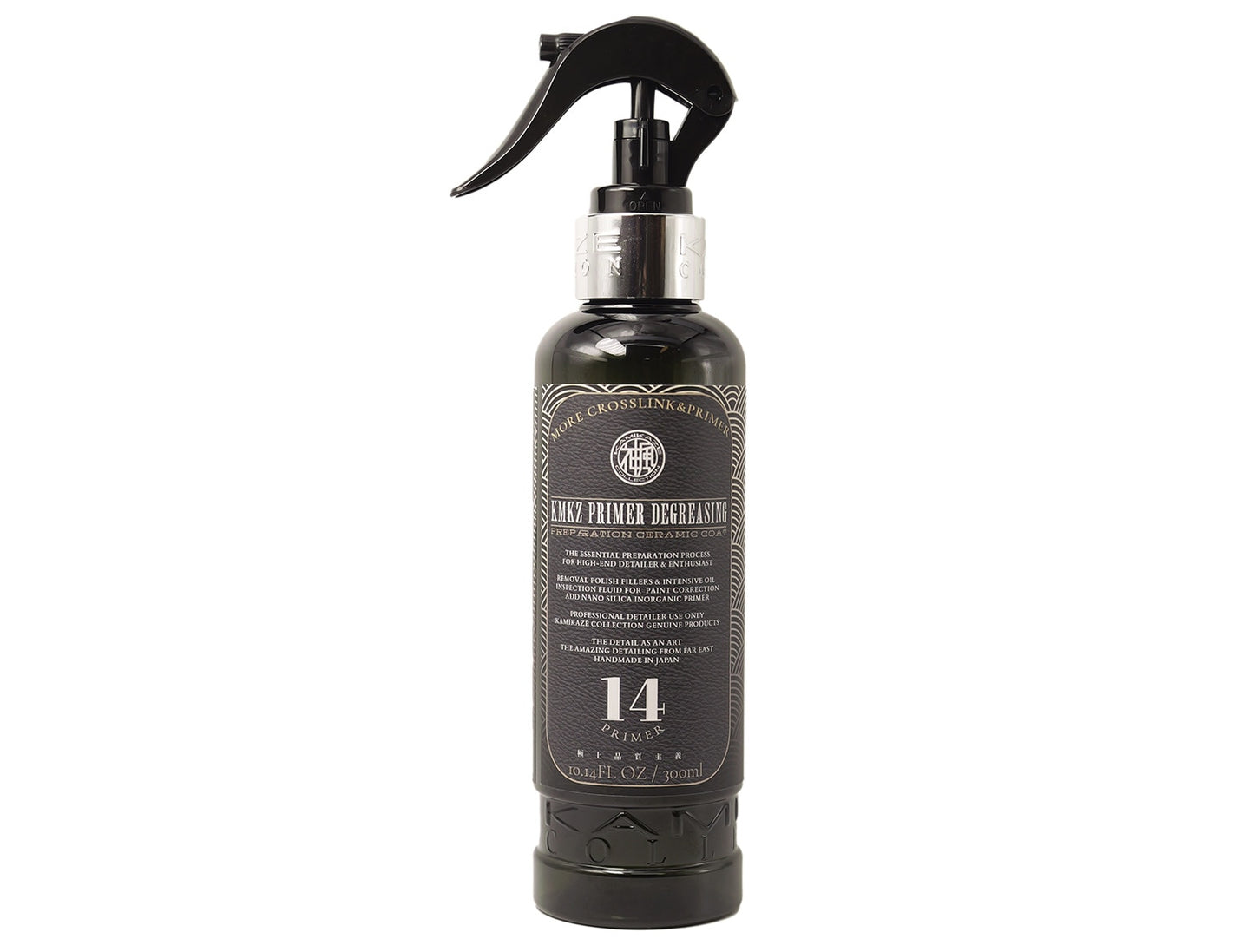

KMKZ PRIMER DEGREASING
THEORY
Aiming for a degreaser and primer in one.
We're ready to offer a degreaser suited to prepping the surface before any of our coatings or waxes.
Our development theory: not too strong, not too weak. It should be functional, and the more you use it, the more you feel you can't do without it.
KMKZ PRIMER DEGREASING combines degreasing and priming in one step, and it is KMKZ's new challenge for the global market.
RECOMMENDED SYSTEM
- Before a coating or wax: Use it as the prep step before any KAMIKAZE COLLECTION coating or wax, including OVER COAT CERAMIC -EVO-.
- After KMKZ AMAZING GLAZE: It is well suited to degreasing after KMKZ AMAZING GLAZE. The filling effect of the hard resin remains, while silicone on the surface layer is removed. If you want a more reliable result when applying a hardening coating over AMAZING GLAZE, we recommend degreasing with this product.
PERFORMANCE
Ceramic silica powder
The primer component is not a siloxane, a silazane or a straight silicone. We added nano-scale inorganic particles. After degreasing, a trace of them remains on the paint and changes the surface feel to a distinctive "squeaky, grippy" texture, as if an inorganic primer had been applied. Ceramic silica is included as a primer to help improve bonding and cross-linking with the inorganic ceramic coating you apply afterward.
Between an IPA-and-water prep spray and a solvent
Many prep sprays on the market are IPA and water, diluted with a small amount of anionic surfactant. A solvent like those used for silicone removal in body shops can dissolve the surface of some paints, such as the finishes on many Japanese-market cars. We aimed for a balance between the two.
A slightly slick feel, and easy removal of polishing dust
If you're new to this product, you may be surprised that a degreaser feels slightly slippery, almost like a lotion. This is intentional. It creates glide between the paint and the microfiber towel, using a surfactant designed not to linger on the paint, which helps reduce wiping marks when you remove polishing dust and residue. This is especially useful on soft, delicate paint.
Prep for hardening coatings
Adding this degreasing step helps improve adhesion for hardening coatings in general, including our inorganic coatings that use methyl groups and low solvent content.
A NOTE FROM OUR CEO
Why we made it
To apply OVER COAT CERAMIC -EVO- reliably and effectively, we started developing a degreaser, something our lineup didn't have until now. We tried degreasers and solvents from Japan and overseas, and we chose raw materials carefully.
We then tested repeatedly whether we could bring into a degreaser a technology we have used for about ten years: turning nano-colloidal ceramic into a powder that adheres to the paint surface. Long-time customers may remember our "Kamikaze Polishing Crystal Water" (discontinued). Left unwiped on a surface, that ceramic water hardens and adheres to the paint. Combining an inorganic material like this with a fast-evaporating water-based degreaser was extremely difficult.
For a primer, what matters is a material that actually hardens on the surface, or reacts with moisture in the air to harden or penetrate. That is how we use the word "ceramic." I worry a little about whether offering an invisible inorganic film as a primer sounds like hype, but many people who received samples noticed the small difference, and that gave us confidence.
Whether the surface has a polysilazane or siloxane-based coating, I feel that an inorganic layer underneath helps bonding, whether the coating's water-repellent group is methyl or fluorine. So I decided to include it, even with today's high costs. I doubt many CEOs would add several hundred yen to the cost of each bottle for something hardly anyone may notice (laughs). But when someone does notice the difference, that is when I'm happiest as a developer.
How it handles polishing dust
That said, the primer effect isn't even the best part. What I like most is how it handles polishing dust. After polishing, it lifts and collects the dust so smoothly and effortlessly. With the right towel and the right motion, you can degrease even dark, soft paint with very few wiping marks.
Many degreasers, including IPA-based products and petroleum solvents, work by dissolving the paint surface. On soft paint, whose molecular structure can be uneven and unstable, that can leave marks on freshly polished paint in no time. That is the risk of degreasers.
Try it on paint covered in polishing dust and enjoy the way it wipes. Forget about the primer effect for a moment (laughs). The surfactant lifts the embedded compound so you can pick it up, then the evaporation timing gives it just the right viscosity and feel when you wipe. The surface afterward feels clean, with no oily residue.
If you looked only at degreasing power, there are plenty of stronger degreasers. And if you want a primer effect, you can always apply an inorganic film with a separate product. What I want to say is that it's the balance, and the motion of using it, that I find beautiful. I'm quite fond of this one.
I hope you'll experience KMKZ's ideal of degreasing. If this subtle craft clicks for you, we probably have a lot in common.
DIRECTIONS
This product is used for degreasing or primer treatment before coating, on paint that has already been washed and properly polished.
- Prepare two towels. Use on a dry paint surface.
- Fold one towel into quarters, apply an appropriate amount, and spread it over the surface.
- Wipe in one direction.
- Wipe off thoroughly with the second towel. Areas that aren't fully wiped off, or that are insufficiently degreased, may turn cloudy.
- Apply your coating within 2 hours after using this product.
FAQ
Q. Why does a degreaser feel slippery?
A. This is intentional. The surfactant creates glide between the paint and the microfiber towel, which helps reduce wiping marks when you remove polishing dust.
Q. How long can I wait before applying a coating?
A. Apply your coating within 2 hours after using this product.
Q. Why did some areas turn cloudy?
A. Areas that aren't fully wiped off, or that are insufficiently degreased, may turn cloudy. Wipe them again with a clean, dry towel.
Safety: Keep out of reach of children. Avoid contact with skin and eyes; wear gloves and eye protection. Use in a well-ventilated area. Keep away from heat and open flame.
PRODUCT INFO
Volume: 300 ml
Ingredients: Special surfactant, propanol, butyl cellosolve, decamethylcyclopentasiloxane, ceramic silica powder, water
Country of Origin: Japan